
Recovery
Nutrition
Nutrition is one of the 3 pillars of recovery which becomes even more important when athletes have a high training load and/or train multiple times per day. Nutrition aims to restore fuel supplies, promote rehydration, support muscle repair and adaptation, and support broader health status. For a more in-depth discussion on nutrition, view our other webpage.
The principles of recovery nutrition (4 R’s)
- Refuel: carbohydrates are the body’s main fuel source. So replace used carbohydrates soon after exercise
- Examples: bread, cereal, pasta, couscous, lentils, beans, fruit in all forms
- Rebuild and repair: Proteins are required for muscle restoration and adaptations
- Examples: red meat, poultry, seafood, dairy, eggs, tofu, textured vegetable protein, dried beans, nuts
- Rehydrate: as we exercise the body cools itself by sweating. It is important to replace this fluid to avoid dehydration
- For exercise of longer duration, higher intensity or in hot environments, often co-ingesting electrolytes (i.e. sports drinks) improves the retention of water
- Revitalise: vitamins and minerals are important to ensure broader athlete health and avoid becoming run down and sick.
- Tip: Eat a variety of foods of all colours of the rainbow especially vegetables
Hydration
Dehydration may start to impact performance when as little as 2% of your bodyweight is lost.
Daily hydration strategies
- Be conscientious of fluid intake. Bring a water bottle with you.
- Drink with meals or snacks. This will take advantage of sodium’s effect of increasing water retention.
- Monitor the colour of your urine.
- Drink when thirsty.
PRE-GAME
- The hydration process should start 12-24 hours before the game.
- Consume 1-2 glasses (250-500mls) of fluid in the hour before training or a match.
DURING TRAINING/GAMES
- Drink well during half time breaks, approximately 1-2 glasses (500mls) at half time.
- Drink more in hot humid conditions and try to drink small amounts throughout the game
POST-GAME
- Start replenishing fluid immediately after a match or training.
- Weigh yourself pre and post-game. For every 1kg difference, replenish with 1.5L of fluid over the 203 hours following competition
Simple Rule: IF YOU ARE THIRSTY, DRINK
Sleep
Sleep is critical for physical and psychological recovery.
Sleep improves reaction time, coordination, decision-making, concentration, memory, mood, and athletic performance. Sleep also repairs and regenerates muscle tissue and maintains a healthy immune system.
Considerations
- Quantity: 7-9 hours per night
- Timing: establish a routine by falling asleep and waking up within a +/- 30 minute window
- Napping: Napping can be beneficial but should follow some guidelines. Nap between 20-90 minutes and finish 60 minutes prior to training/competition. Napping should not impact nighttime sleep in any way.
- Establish an electronic device routine around bedtime.
- Consider wearable devices for tracking long-term trends in sleep duration
- Natural sunlight exposure regulates the body’s internal clock. Disrupting this with evening bright light may impact your ability to fall asleep.
- Avoid large meals within 2-3 hours of bedtime and large volumes of fluid to prevent waking up throughout the night.
- Aim for a dark, quiet, cool (18-21 degree) room.
- Use relaxation techniques to help unwind at the end of the day.
Cool-downs
Cool-downs are implemented immediately after competition or training bouts and involve a progressive reduction in effort and intensity. Cool-downs have long been a mainstay in recovery routines as they have been suggested to reduce delayed onset muscle soreness, increase range of motion and reduce stiffness. However recent scientific evidence shows that a cool-down does not improve post-exercise DOMS, ROM, and strength any quicker than passive rest. Unfortunately, the quality of included studies remains low and no study involved the use of dynamic stretching, therefore we cannot make definite conclusions on the effectiveness of cool-downs. Despite this, it seems that cool-downs will at least not be a detriment to recovery.
Water Immersion
- Involves immersion of the whole-body to improve venous return (rate of blood flow back to the heart) and heat transfer
- Athletes may report a reduction in perceived soreness and fatigue following competition or training.
Considerations
- Immersion temperature, duration and depth
- Cold water immersion (CWI) temperatures are typically between 10-15 degrees Celsius for 10-15 minutes.
- Hot water immersion (HWI) temperatures are typically between 38-40 degrees for 10-15 minutes.
- Immersion up to the neck will optimise benefits.
- When to use
- Pre-season/ general preparation phases: CWI can be used following technical/skill-based sessions. Minimise CWI use if the goal of the training session is related to strength or hypertrophy
- In-season/ specific preparation phases: CWI use may be increased following or in readiness for priority sessions
- Frequency
- Increased use may be beneficial when competing frequently to reduce muscle soreness and enhance subsequent neuromuscular performance
- CWI may be effective between same day competitive efforts assuming there is adequate time to re-warm.
- Environment
- CWI can reduce physiological strain and improve thermal comfort when exercising in the heat.
- In cooler weather, HWI is more appropriate.
- Contrast water therapy
- Alternating water temperature may promote metabolite removal via vasodilation and vasoconstriction.
- Perform for similar times as both CWI and HWI.
- When alternating between CWI and HWI, it is important to finish the session in cold water to leave the body with a cooling stimulus.
Sports compression garments (SCG)
SCG (e.g. tights, socks, tops) are designed to apply external pressure to the limb. They should be a challenge to get on and pressure should be noticeable without restricting movement.
The effect of SCG is not fully understood however these are a summary of the key findings of scientific research so far:
- No negative effects on physical performance
- Increased skin but not core temperature
- Cardiorespiratory measures largely unchanged
- Blood indices (lactate, muscle damage) unchanged
- Reduced muscle soreness and swelling
- No additive benefit to sleeping with SCG
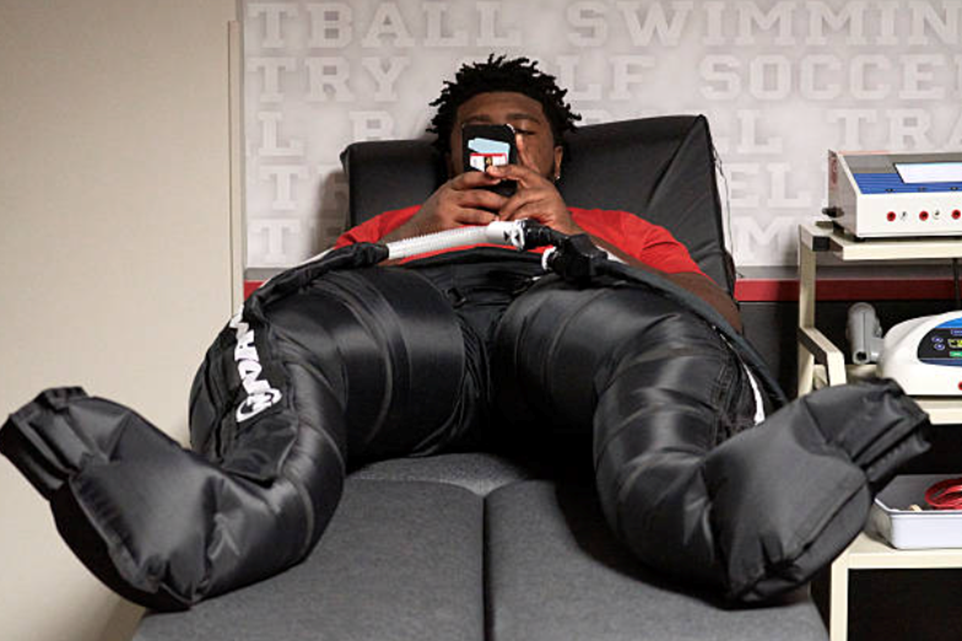
Intermittent Pneumatic compression (IPC)
Inflatable sleeves which apply dynamic compression to the veins, facilitating the muscle-pump action, increasing venous return and blood flow. These can reach 5x the compression of standard SCG.
Similarly to SCG, the effectiveness is not well understood in the research. Typically worn between 20-60 minutes. It is recommended to start with less compression and duration and slowly build up to establish optimal comfort.
Potential applications
- Use as a form of passive recovery while relaxing
- Use between events
- Use to compliment physical therapy during rehabilitation of an acute soft issue injury (e.g. muscle strain)
Afonso J, Clemente FM, Nakamura FY, Morouço P, Sarmento H, Inman RA and Ramirez-Campillo R (2021) The Effectiveness of Post-exercise Stretching in Short-Term and Delayed Recovery of Strength, Range of Motion and Delayed Onset Muscle Soreness: A Systematic Review and Meta-Analysis of Randomized Controlled Trials. Front. Physiol. 12:677581. doi: 10.3389/fphys.2021.677581
Make A Booking
Caringbah Practice
Level 1/191 Taren Point Rd (opposite McDonald’s)
Caringbah, NSW 2229
Call: (02) 9540 9400
Kareela Practice
12 Freya St (opposite Kareela Shopping Village)
Kareela, NSW 2232
Call: (02) 9528 2200
Kogarah Practice
51 President Avenue (diagonally opposite Ilinden Sports Centre)
Kogarah, NSW 2217
Call: (02) 9540 9400
Email us at: office@jubileesportsphysio.com.au